
Privatising public sector companies would have encountered significant opposition from their managers as well as from strong unions.

The top two in the government and in the Bharatiya Janata Party, Prime Minister Narendra Modi and party President Amit Shah, respectively, spent the day trying to hard sell not just the contentious land Bill but also how the Modi government stood for the welfare of farmers.
With GDP down by 2 per cent, while 99 per cent of banned notes make way back to the banking system, whom did demonetisation benefit?

In a surprise announcement in April, Sun and Ranbaxy -- at that time owned by Japan's Daiichi -- declared an all-stock deal to create India's largest and world's fifth-largest drugmaker in an over $4 billion deal.

Contentious issues such as the construction of a Ram Temple in Ayodhya, abrogation of Art 370 giving special status to Jammu and Kashmir and enactment of Uniform Civil Code have been included in the Bharatiya Janata Party's election manifesto with the party making promises on them.

'If majority of the country's population is sentimental about a certain species, why are we so ashamed to say that we want to give it statutory protection?'

Here's a collection of images of the past week.

Ahead of the assembly elections next year, the BJP has been wallowing in a welter of ideas that has resurrected the debate on populism versus pragmatism, as it has to pander to two important but incompatible constituencies, of the freebie consuming masses and Bengaluru's heavy hitters craving for even roads, pristine lakes and unbroken power supply, reports Radhika Ramaseshan.

With only one day left, the Winter session of Parliament is on the verge of a washout as it failed to transact any business again on Thursday.

President Pranab Mukherjee on Monday addressed the first joint sitting of Parliament as mandatorily required under the Constitution after the general elections. The address is the political, economic and foreign policy road map of the Narendra Modi government and covers virtually all crucial areas.
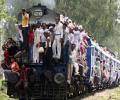
'There is tension between the zones all the time.'

'The root of the Kashmir problem lies in Partition. To solve the issue, we have to begin from there and settle it forever.'

Non-Congressism is the answer to India's current difficulties, says Dr Shambhu Shrivastava, who gives a historical perspective of non-Congress experiments in 1967, 1977, 1989 and 1998.
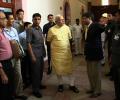
Who are the men the prime minister relies on to execute his impressive agenda?

The Forbes 30 Under 30 list is harder to get into than Stanford or Harvard University. Meet the desis who made the cut this year.

Indian economy about to take-off
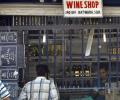
State after state has imposed an alcohol ban, and has had to retreat, unable to address the financial and administrative fallout. Are we set for more of this cycle, asks Aditi Phadnis.

'Consider this image of today's youth in Bihar -- armed with a bike, a smartphone and possibly some illegal arms too, imbibing incessant stream of images from the Internet and television.' 'Some of them would turn into gau bhakts, some would listen with interest the exploits of Salafism, dig deep into the Internet to come out with images which cry vociferously that their respective religions are in danger.'

The year 2014 is coming to an end. It was the year of conflict, the year of strife. Year 2014 will be remembered for several reasons -- the rise and threat of the Islamic State, the downing of two Malayasia Airlines aircraft and the sudden and effective way of using hastags on social media to generate a buzz about the event. After all, who can forget #theicebucket challenge and the phenomenon it grew into. Read on as we bring you an overview of international news and events of 2014.
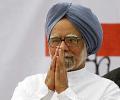
The most immediate cause of worry is the recent volatility in foreign exchange markets, Prime Minister Manmohan Singh tells the Assocham annual general meeting.
